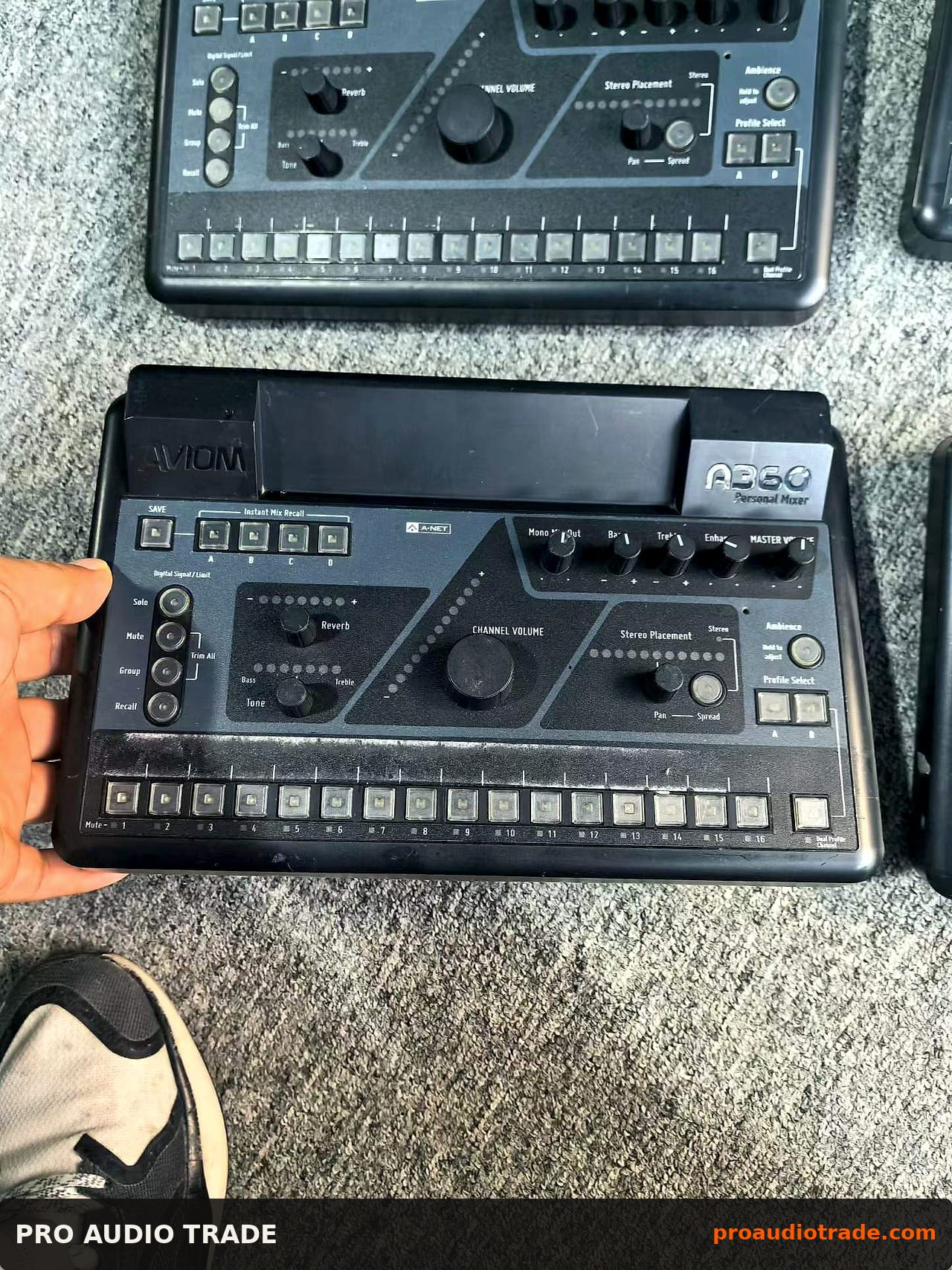
The Aviom A360 Personal Mixer is a staple in houses of worship, rental inventories, and integration projects where musicians need direct control over their monitor mix. But with used gear budgets under pressure and alternatives from Behringer, Allen & Heath, and Midas flooding the secondary market, wholesale buyers need a clear-eyed comparison. This guide breaks down where the A360 fits, what to inspect on used units, and how to evaluate total cost of ownership before you commit to a bulk order.
Where the A360 fits in a rental or venue inventory
The A360 is a 16-channel personal mixer with a built-in A-Net interface, designed for use with Aviom's Pro16 or Pro64 networks. In rental fleets, it shines in fixed installations—churches, theaters, and corporate AV rooms—where the A-Net backbone is already in place. For mobile rental firms, the A360 is less flexible than Dante-based alternatives because it requires an Aviom network card or AN-16/i input module to interface with a console. Integrators in the CIS and Middle East often specify Aviom for its proven reliability and simple Cat5e cabling, but the ecosystem lock-in is real. If your clients already own Aviom gear, the A360 is a natural add; if they are starting fresh, compare against Dante-native personal mixers before committing.
Key specs that matter for integration work
The A360 offers 16 channels, each with volume, pan, and mute, plus a master section with EQ and reverb. It supports stereo or dual-mono operation and can be powered over A-Net or via a local PSU. For integration, the critical spec is network compatibility: the A360 works with Pro16 and Pro64 A-Net, but not with Dante or AES67 without a bridge. Channel labeling is done via the A360's front-panel buttons or through Aviom's console software—there is no touchscreen, which some users find slower than the Behringer P16-M's interface. The headphone amp is robust and drives high-impedance cans well, a common failure point on cheaper alternatives. For fixed installs, the A360's metal chassis and locking connectors are a plus; for rental, the lack of a carrying case and the proprietary network card requirement are drawbacks.
Used-buying checklist: what to inspect and what to ask
On a used A360, start with the headphone jacks—they are the most common failure point due to mechanical stress. Test both outputs with a known-good pair of headphones and check for crackling or channel dropouts. Inspect the A-Net ports for bent pins or loose solder joints; repeated cable swaps can damage the RJ45 connectors. Power over A-Net is convenient but can stress the internal regulator—ask the seller to confirm the unit powers on reliably from both A-Net and a local PSU. Check the encoder knobs for smooth operation and no skipped steps; replacement encoders are available but require soldering. Ask for the serial number and confirm it is not from a recalled batch. Request photos of the rear panel and a short video of the unit powering up and passing audio on all 16 channels. For bulk orders, insist on a test report per unit—reputable B2B sellers will provide one.
Price context and total cost of ownership
Used A360 units typically trade in the $250–$400 range depending on condition and accessories, compared to $600–$700 new. Alternatives like the Behringer P16-M sell used for $150–$250 but have a higher failure rate on headphone amps and encoders. The Allen & Heath ME-1 is Dante-native and commands $400–$600 used, but eliminates the need for an A-Net bridge—a significant saving if your client is building a new Dante network. Total cost of ownership for the A360 includes the A-Net card or AN-16/i module ($300–$500 used) if not already present, plus Cat5e cabling. For rental firms, the A360's metal chassis survives transport better than the plastic Behringer, but the lack of a case means you should budget for protective covers. In CIS and African markets, spare parts availability favors Aviom over Behringer, which matters for long-term fleet maintenance.
How a B2B order works: grade, freight, MOQ
Wholesale used gear is graded A, B, or C. Grade A units are fully tested, cosmetically clean, and include accessories; Grade B may have minor scuffs but passes all functional tests; Grade C is sold as-is or for parts. For A360 orders, specify Grade A or B with a test report. MOQ varies by seller—typically 5–10 units for mixed pallets, but single-unit orders are possible at a premium. Freight from EU or US warehouses to CIS, Middle East, South America, and Africa is usually by air for small quantities and sea for pallets; ask for DDP pricing to avoid customs surprises. Confirm voltage compatibility—A360 PSUs are external and often 100–240V, but verify. Request photos of actual units, not stock images, and clarify the return policy for DOA units.
Closing takeaway
The Aviom A360 remains a solid choice for existing A-Net installations, but for new builds, Dante-native alternatives offer better long-term flexibility. Buy used Grade A/B units with test reports, budget for network cards, and confirm freight terms before ordering. For rental fleets in regions where Aviom support is strong, tested used stock delivers reliable performance at half the new price.