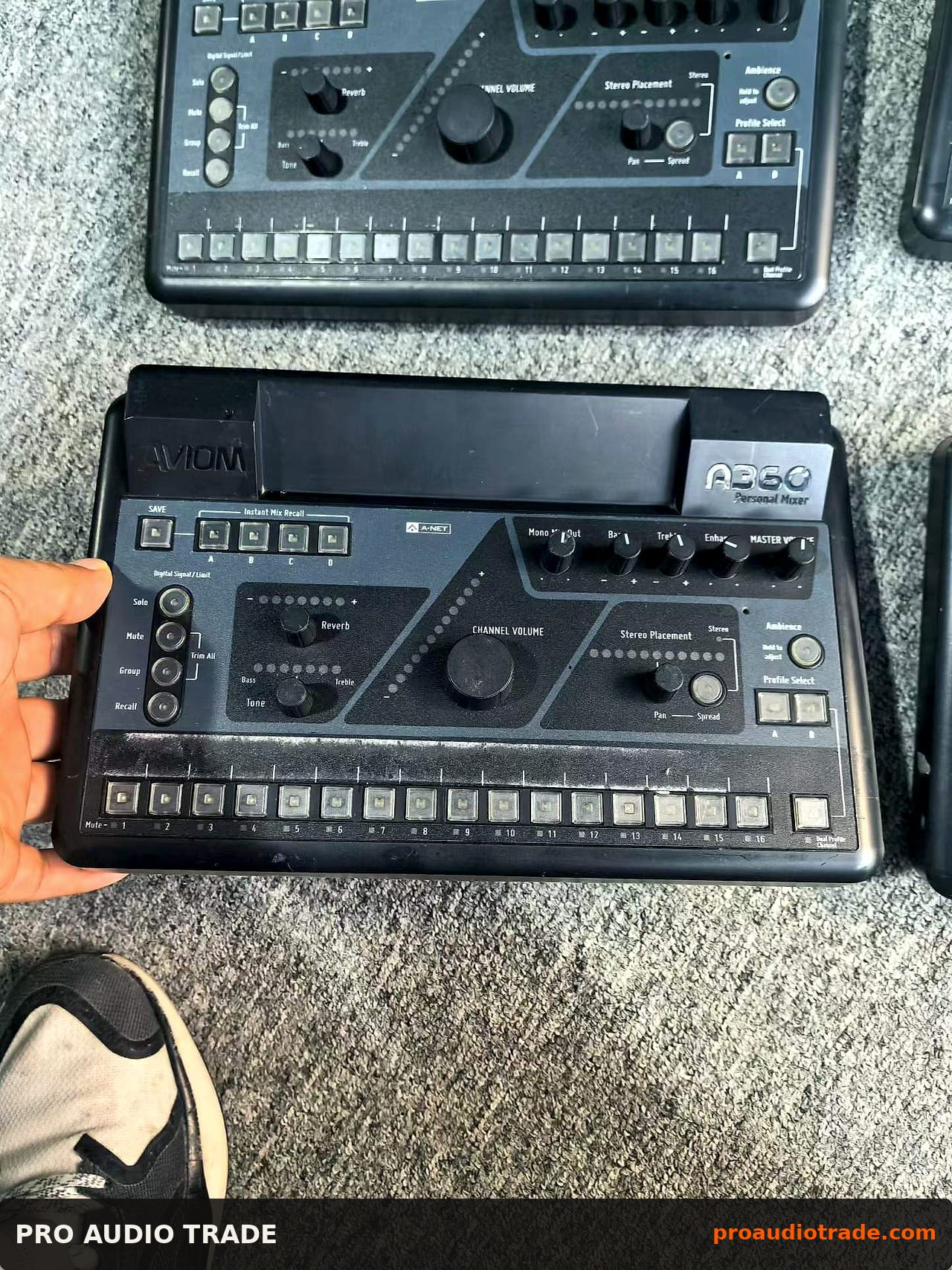
The Aviom A360 Personal Mixer is a staple in houses of worship, rental companies, and integrators who need reliable personal monitoring without the cost of a full digital console upgrade. For B2B buyers in the CIS, Middle East, South America, and Africa, the used market offers significant savings—but only if you know what you're buying. This guide covers where the A360 fits in a professional inventory, what specs matter for integration, how to inspect a used unit, price context, and how wholesale orders work.
Where the A360 fits in rental and venue inventory
The A360 is a 16-channel personal mixer designed for A-Net networks, typically paired with Aviom's AN-16/i input module or a console interface card. It's popular in fixed installations—churches, broadcast studios, theaters—and in rental fleets serving corporate events and live music. Unlike generic headphone amps, the A360 gives each performer independent control over their mix, which reduces monitor wedge clutter and saves on stage space. For rental firms, it's a high-utilization item: easy to deploy, hard to break, and familiar to engineers who've worked with Aviom systems. Integrators appreciate that it runs on Cat5e/6 cabling and can be daisy-chained or star-topology depending on the A-Net distributor. In regions where new stock is expensive or slow to import, tested used A360s keep projects on budget without sacrificing channel count or build quality.
Key specs that matter for integration work
The A360 offers 16 channels with 2-band EQ per channel, a master EQ, and stereo linking. It has two headphone outputs (one on the front, one on the back) and can drive both simultaneously—useful for shared monitoring stations. The rear panel includes A-Net in/out, a 12V DC power jack, and a 1/4-inch TRS line output for feeding a powered speaker or recorder. The display is a backlit LCD with a rotary encoder for navigation; it's not touchscreen, but it's rugged and readable in dim stage light. For integration, the critical point is A-Net compatibility: the A360 works with Aviom's Pro16 and Pro64 series, but firmware versions can affect channel mapping and compatibility with newer AN-16/i modules. Always confirm the firmware version and ask whether it's been updated. The unit is fanless, which matters in quiet environments like broadcast booths. Power supplies are external and a common failure point—check that the original 12V adapter is included or that a compatible replacement is available locally.
Used-buying checklist: what to inspect and what to ask
Start with the physical condition: cracked LCD screens are common if units have been dropped, and replacement displays are not always easy to source. Test every encoder and button for responsiveness—the rotary encoder can become jumpy with wear. Check both headphone jacks with a known-good pair of headphones; listen for channel imbalance or noise. Verify that all 16 channels pass signal by connecting a known source to an A-Net input module and testing each channel's level and EQ. Ask the seller for the firmware version and whether the unit has been used in a fixed install or on the road—road units may have more cosmetic wear but are often functionally sound. Request photos of the rear panel, including the power jack and A-Net ports, to check for bent pins or corrosion. Ask if the unit has been bench-tested with a Pro16 or Pro64 system, and whether any error codes appeared during boot. For B2B orders, request a test report or at least a written confirmation of functionality. Avoid units sold as "untested" unless the price reflects the risk.
Price context and total cost of ownership
Used A360 prices vary by region and condition. In the CIS and Middle East, expect to pay roughly 40-60% of the new street price for a tested unit in good cosmetic condition. In South America and Africa, import duties and freight can add 20-30% to the landed cost, so sourcing from a regional distributor with stock already in-country often makes more sense than a direct import. A new A360 typically lists around $700-900 USD, so a used unit in the $300-500 range is realistic for tested stock. Factor in the cost of a replacement power supply ($20-40) and possibly a firmware update if you have an older A-Net system. Total cost of ownership is low: the A360 has no moving parts, no fan, and a long service life. The main risk is buying a unit with a failing encoder or LCD, which can cost $100-200 to repair if parts are available. For rental fleets, the payback period is short—a single corporate event rental can cover a significant portion of the unit's cost.
How a B2B order works: grade, freight, and MOQ
Wholesale used gear is typically graded A, B, or C. Grade A means near-mint cosmetic condition with full functionality; Grade B has minor scuffs but works perfectly; Grade C may have cosmetic damage or missing accessories but is functional. For the A360, Grade B is often the best value for rental fleets, while Grade A suits fixed installations where appearance matters. MOQs vary: some sellers require 5-10 units per order, while others will sell singles. Freight is usually arranged by the buyer or through the seller's forwarder; for cross-border shipments, confirm whether the seller provides export documentation and whether the units are packed in original boxes or custom foam. Ask about warranty—many B2B sellers offer a 30-90 day warranty on tested used gear. For buyers in regions with unreliable power, request that units be tested with a stable power supply and ask about surge protection recommendations. Payment terms are typically T/T or LC for larger orders; smaller orders may be PayPal or wire transfer. Always clarify Incoterms (FOB, CIF, DDP) before committing.
Used Aviom A360 mixers are a smart buy for B2B audio professionals who need reliable personal monitoring without new-gear pricing. Focus on tested units with confirmed firmware and a clear return policy, and factor in freight and duties for your region. With a little diligence, you can build a cost-effective inventory that serves rental clients and installations for years.