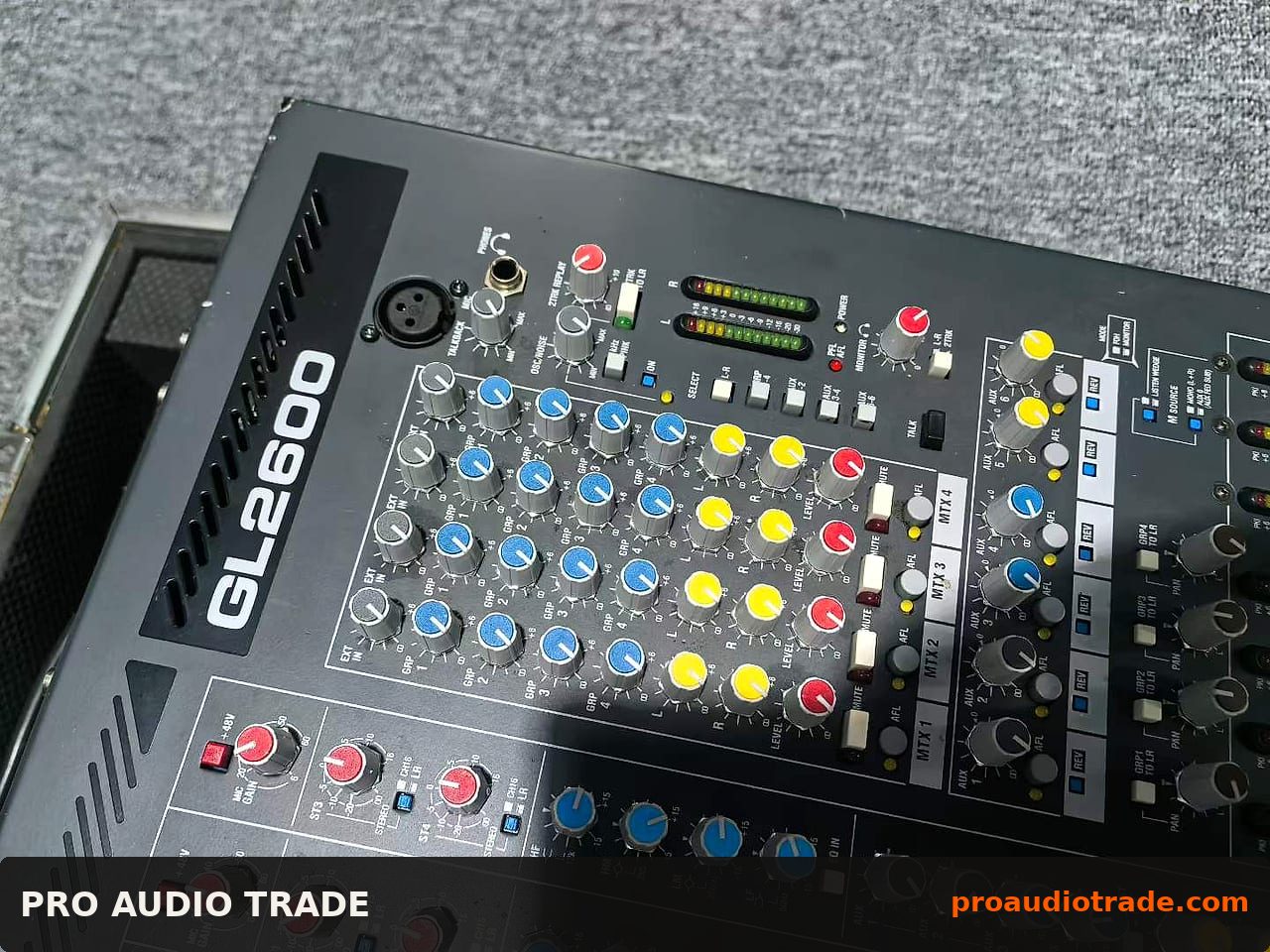
The Allen & Heath GL2600 is a workhorse analog console that still earns its place in rental inventories, houses of worship, and small venues across the CIS, Middle East, South America, and Africa. If you are sourcing used units for resale, integration, or fleet expansion, understanding the real market price—and what drives it—is essential. This guide breaks down where the GL2600 fits, what to inspect, how pricing works, and how to buy tested stock with confidence.
Where the GL2600 fits in a rental or venue inventory
The GL2600 is a 24-channel (or 32-channel, depending on version) analog mixing console with 4-band EQ, 6 aux sends, and a compact frame that suits front-of-house positions in clubs, conference rooms, and multi-purpose halls. It is not a touring-grade desk, but it is reliable, intuitive for volunteer operators, and easy to service. For rental firms, it fills the gap between small format mixers and digital consoles—clients who need more inputs but refuse to learn a digital workflow. In integrator projects, it is often specified for permanent installs where budget is tight and analog simplicity is a feature, not a limitation. Used units are particularly attractive for houses of worship and community venues in emerging markets where new analog consoles are either unavailable or overpriced.
Key specs that matter for integration work
The GL2600 offers 24 or 32 mono channels with XLR mic inputs and 1/4-inch line inputs, 4-band EQ with swept mid, 6 aux sends (2 pre, 2 post, 2 switchable), and 4 subgroups. It has a 7x4 matrix, direct outs on every channel, and a built-in power supply. For integration, the direct outs and insert points are valuable for recording or streaming feeds. The console’s balanced XLR main outputs and TRS aux outputs interface cleanly with amplifiers and DSPs. However, note that the GL2600 lacks digital connectivity—no USB, no Dante—so it suits analog-only signal chains. The frame is heavy (around 20–25 kg depending on channel count), so plan rack or table mounting accordingly. Power supply voltage is typically 100–240V switchable on later units, but early versions may be fixed—confirm before shipping to regions with different mains voltages.
Used-buying checklist: what to inspect and what to ask
Start with the power supply. The GL2600’s internal PSU is a common failure point, especially in units that have been rack-mounted in dusty environments. Ask the seller for a photo of the PSU board and confirm whether it has been recapped. Next, check the channel strips: scratchy faders, dead EQ pots, and intermittent aux sends are typical on high-mileage desks. Request a video of every channel passing signal through the mic input, line input, and direct out. Test the subgroups and matrix routing—these are often neglected and can have dirty switches. Inspect the master section for crackling in the monitor and headphone outputs. Ask for the serial number to verify age and version. Finally, confirm that all knobs and fader caps are present; replacements are available but add cost. For B2B orders, insist on a test report or a short video walkthrough of the unit powered up.
Price context and total cost of ownership
Used Allen & Heath GL2600 prices vary widely by region, condition, and channel count. In Europe and the UK, working units typically list between €800 and €1,500 for 24-channel versions, with 32-channel desks reaching €1,800–€2,200. In the CIS and Middle East, prices are often 10–20% higher due to import logistics, while South America and Africa may see 20–30% premiums. However, the headline price is only part of the story. Budget for a service check (€100–€200), replacement faders (€10–€20 each), and freight. A console that costs €900 but needs €300 in parts and labor is no bargain. Tested, graded stock from a reputable B2B seller typically commands a 15–25% premium over as-is units, but it reduces downtime and returns. For rental fleets, downtime costs more than the price difference. Also consider that analog consoles hold value better than digital in some markets because they are easier to repair locally.
How a B2B order works: grade, freight, and MOQ
Most B2B wholesale platforms grade used gear as A (fully tested, minor cosmetic wear), B (functional with visible wear), or C (for parts or repair). For the GL2600, Grade A units are ideal for client-facing rentals; Grade B suits installs where cosmetics matter less. MOQ varies—some sellers require 1 unit, others 3–5 for export pricing. Freight is the wildcard: a 25 kg console shipped from Europe to the Middle East can cost €200–€400 by air or less by sea, but sea freight adds 4–8 weeks. Always request a proforma invoice with Incoterms (FOB, CIF, or DAP) and confirm whether the seller handles export documentation. For CIS destinations, ensure the seller can provide a certificate of origin and customs paperwork. Ask about packing: original foam and box are best, but double-walled cartons with foam inserts are acceptable. Finally, clarify the warranty—tested used gear often comes with a 30–90 day warranty, which is a strong signal of seller confidence.
Sourcing a used Allen & Heath GL2600 is a balance of price, condition, and logistics. The console remains a solid choice for budget-conscious rentals and installs, but only if you buy tested stock and account for service costs. Use the checklist above, ask for video proof, and factor freight into your landed cost. A well-chosen used GL2600 can deliver years of reliable service at a fraction of the cost of a new digital desk.