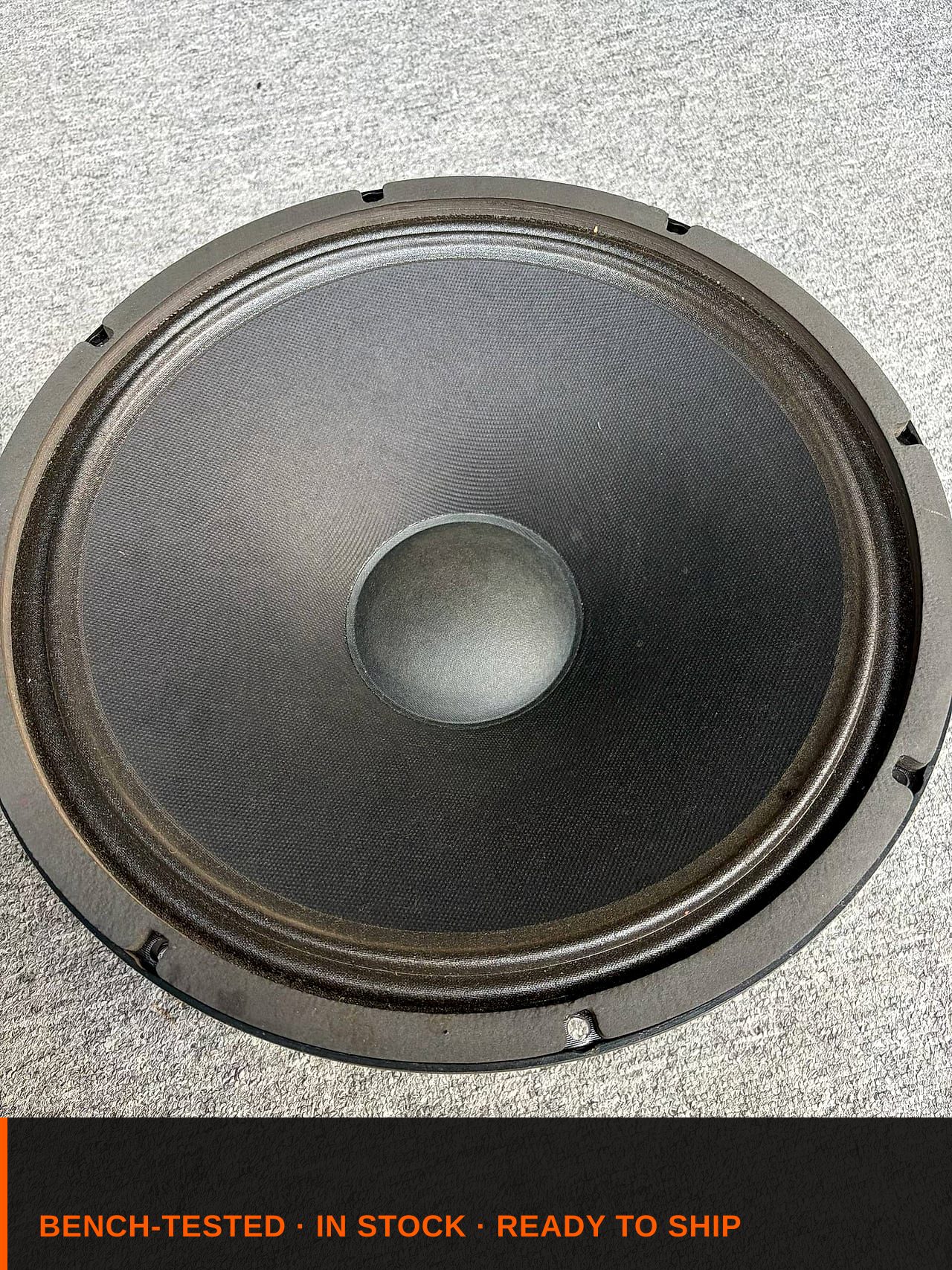
The Eminence 151351D is a 15-inch, 8-ohm woofer that has become a quiet workhorse in rental inventories and fixed installs across the CIS, Middle East, South America, and Africa. It is not a boutique driver, but it is a known quantity: cast-frame construction, a 3-inch voice coil, and a power rating that makes it suitable for both full-range PA boxes and dedicated subwoofer duty. For B2B buyers sourcing used stock, the 151351D represents a sensible balance of availability, repairability, and price-to-performance. This review covers what the model actually does in the field, what to inspect on a used unit, how pricing works, and how to structure a wholesale order without surprises.
Where the 151351D fits in a rental or venue inventory
In rental fleets, the 151351D typically shows up as a replacement driver for 15-inch two-way tops and as a mid-bass or low-mid component in compact subs. Its 8-ohm impedance makes it easy to pair in parallel, and the cast aluminium frame holds up better than stamped steel in road cases and truck packs. Venues that run passive systems appreciate the predictable TS parameters, which make box modelling straightforward when a client needs a quick replacement without redesigning the cabinet. Integrators in the Middle East and Africa often use it in houses of worship and conference rooms where the SPL demand is moderate but reliability over long duty cycles matters more than raw output. In South America, it is a common choice for regional touring rigs because spare parts and recone kits are relatively easy to source through Eminence's distributor network. The driver is not a high-excursion subwoofer, so it is best deployed in vented boxes tuned for music playback rather than in horn-loaded sub designs that demand extreme Xmax. For rental firms, the practical value is that a single SKU can cover multiple cabinet types, which simplifies spares stocking.
Key specs that matter for integration work
The 151351D carries a 3-inch voice coil on a polyimide former, which is a meaningful detail: it handles heat better than lower-grade formers and is less prone to deformation when the driver is pushed hard for long periods. Power handling is typically rated around 400–500 watts AES, depending on the exact revision, and sensitivity sits in the mid-90s dB range, so it does not demand exotic amplification. The cast frame is a genuine advantage in installs where the driver is mounted vertically or in ceilings, because it resists flex and keeps the gap alignment stable. The 8-ohm impedance is the standard for parallel wiring in four-driver arrays, giving a 2-ohm load per channel on most amps. For integrators, the important spec is the mounting bolt pattern and cutout diameter, which are consistent across most 15-inch Eminence frames, making retrofit into existing cabinets straightforward. The cone and dust cap materials are conventional treated paper, which is repairable and predictable in humid climates, though it does require proper storage. Buyers should confirm the exact revision letter, as Eminence has made minor changes to spiders and cones over the years, and mixing revisions in a single cabinet can cause subtle tonal mismatches.
Used-buying checklist: what to inspect and what to ask
Start with a visual inspection of the cone and surround. Look for hairline cracks near the neck of the cone, separation at the surround-to-frame glue joint, and any signs of water staining, which is common in gear that has been stored in non-climate-controlled warehouses. Push gently on the cone at several points around the circumference; any scraping or rubbing sound indicates voice coil misalignment or a shifted magnet, which is a deal-breaker. Check the spider for sagging by laying the driver face-up and observing whether the cone sits level. Measure DC resistance with a multimeter: a healthy 8-ohm driver should read roughly 6.0–7.2 ohms cold, and a reading far outside that range suggests a damaged coil. Ask the seller for a sweep test result, ideally a impedance curve or a pink-noise burn-in report, and request photos of the terminals and the frame edges for signs of corrosion. For B2B orders, insist on a graded condition report: A-grade for tested, fully functional units with minor cosmetic wear; B-grade for working drivers with cosmetic damage or older recones; C-grade for parts or recone candidates. Ask whether the drivers have been reconed with OEM kits or aftermarket parts, because aftermarket recones can change the TS parameters and alter box tuning. Finally, confirm the manufacturing date or revision code if the seller has it, and ask for the original box quantity and pallet dimensions to plan freight.
Price context and total cost of ownership
Used 151351D drivers typically trade at a fraction of new street price, and the spread depends heavily on grade and region. In the CIS and Middle East, where import duties and freight add to landed cost, tested A-grade used units often make more economic sense than new stock for rental fleets that need volume. The total cost of ownership calculation should include recone cost, which for a 15-inch Eminence driver is modest compared with replacing an entire cabinet, and the labour to swap drivers in the field. A B-grade unit that needs a recone can still be a good buy if the frame and magnet are sound, because the recone restores the driver to near-new performance. Freight is the variable that often erases the savings on small orders: a single 15-inch driver ships as a bulky parcel, so consolidating into pallet quantities reduces per-unit logistics cost significantly. Buyers in Africa and South America should factor in customs clearance time and the risk of damage in transit, which is why tested stock with proper packaging commands a premium. The practical rule is to compare landed cost per tested driver against the cost of a new unit plus the downtime risk of an untested used one; for most rental firms, tested used stock wins on both counts.
How a B2B order works: grade, freight, MOQ
Wholesale orders for used pro audio drivers usually follow a graded-stock model. The seller provides a condition report per lot, and the buyer selects a grade and quantity. MOQs vary: some suppliers set a minimum of 10–20 units per order to justify pallet freight, while others allow mixed pallets with other drivers. Freight is typically arranged by the buyer's forwarder or through the seller's preferred carrier, and for CIS destinations, road freight via Poland or the Baltics is common, while Middle East and Africa shipments often move through Jebel Ali or Mersin. Ask for the HS code and a commercial invoice that matches the declared value, because customs in many of these regions scrutinise used audio gear. Payment terms for first orders are usually T/T in advance or a deposit with balance against shipping documents; established buyers can negotiate net terms. Confirm whether the price is EXW, FOB, or CIF, because the difference in responsibility for export packing and insurance is significant. For a first order, request a sample unit or a video inspection of the actual lot, and specify that drivers be shipped in individual foam-lined cartons rather than loose in a pallet box. A clear written grade definition in the purchase order protects both sides if a dispute arises over cosmetic condition.
Used Eminence 151351D stock is a practical choice for rental firms and integrators who need reliable 15-inch drivers without new-stock pricing. The key is to buy tested, graded units with documented sweep results, confirm the revision and recone history, and consolidate freight to keep landed cost sensible. Treat the purchase as a supply-chain decision rather than a one-off bargain hunt, and the 151351D will earn its place in your spares inventory.