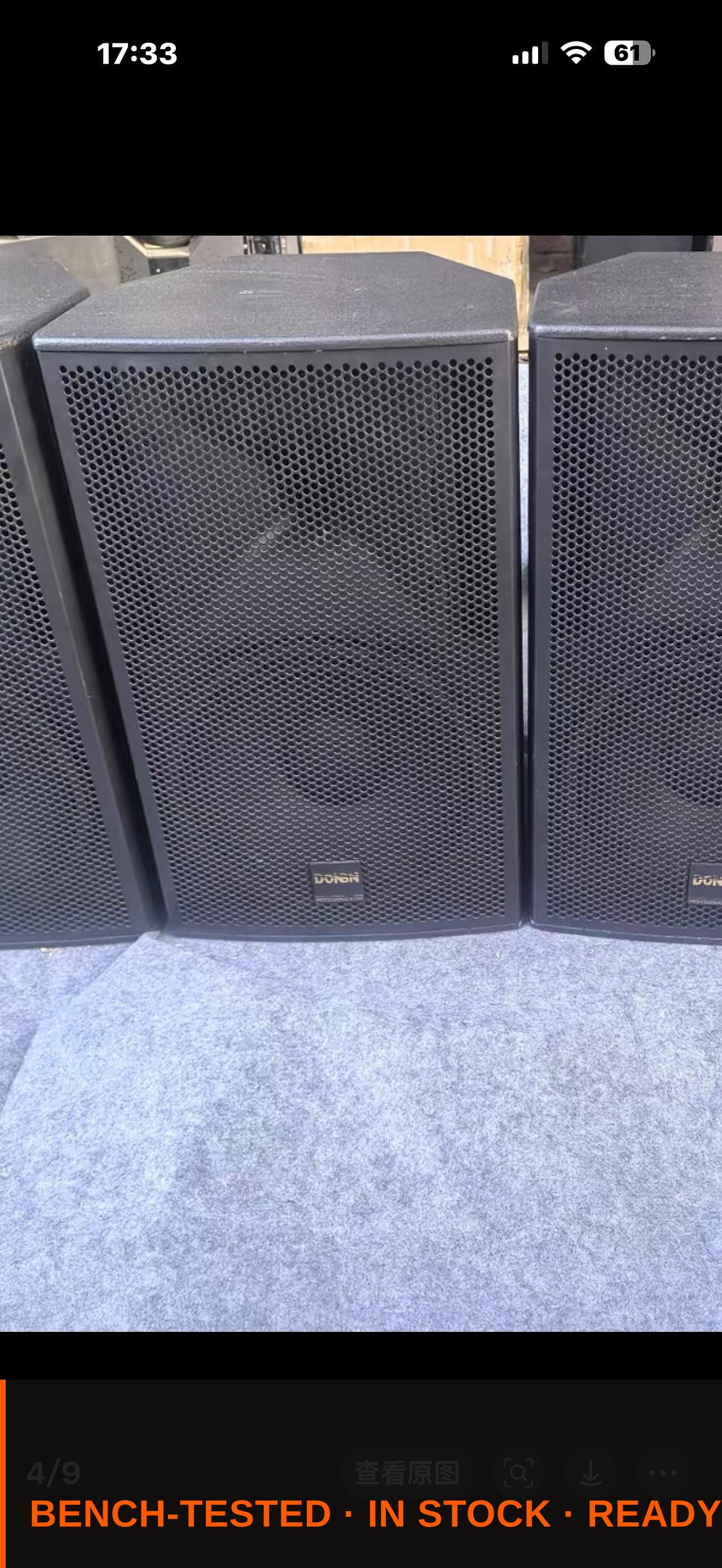
If you are sourcing a used DONBN DW-12 for a rental fleet, a fixed install, or a resale lot, the price you see on a listing is only the starting point. The real question is what that number includes: tested condition, accessories, freight terms, and the risk of hidden faults. This article breaks down where the DW-12 fits in professional audio inventories, what to inspect before you commit, how used pricing behaves across regions, and how a B2B order actually works when you are buying for a project rather than a home studio.
Where the DW-12 fits in rental and venue inventories
The DONBN DW-12 is a 12-inch two-way active loudspeaker aimed at small-to-mid rental jobs, corporate events, houses of worship, and fixed installs where a compact, self-powered box is preferred over separate amp racks. In CIS and Middle East rental fleets it often shows up as a fill or delay speaker alongside larger line arrays, while integrators in South America and Africa use it for distributed audio in retail, hospitality, and education projects where local service access matters more than brand prestige. Because it is active, it reduces rack space and cabling, which is a real advantage when a venue has limited amp room or when a rental company wants fast turnarounds between jobs.
The DW-12 is not a flagship touring box, so buyers should treat it as a workhorse: it earns its keep when it is reliable, easy to transport, and cheap enough to replace. That framing matters for pricing. A used DW-12 is competing less against new DW-12 stock and more against other used 12-inch active boxes in the same condition band. If you are building a fleet, consistency of model and firmware matters, so buying several units from one seller with a known service history is usually worth a small premium over scattered single-unit deals.
Key specs that matter for integration work
For integration buyers, the headline is the active 12-inch woofer with a compression driver on top, built-in amplification, and a molded enclosure with pole mount and rigging points. What actually matters on site is the input section: check whether the unit offers balanced XLR and TRS inputs, a link output, and a usable level control with detents. On used units, scratchy or noisy level pots are common and cheap to fix but annoying to discover mid-install. Confirm the crossover and DSP behavior if the version you are buying has preset modes; some DW-12 variants ship with different firmware or voicing, and mismatched units in one room will not array cleanly.
Power is the other integration issue. Confirm the voltage configuration and whether the unit is switchable or fixed for 220-240V, which is what most CIS, Middle East, and African markets need. A 110V unit imported into a 230V market is a paperweight unless you plan to rewire or use a step-down transformer, and that cost kills the deal. Check the IEC inlet type and whether the power cable is included; original locking IEC cables are often lost. Finally, look at the rigging hardware: missing pole-mount cups, bent fly points, or stripped inserts are structural issues, not cosmetic ones.
Used-buying checklist: what to inspect and what to ask
Start with the drivers. Ask the seller for a close-up photo of each cone and dust cap, and a short video of the unit playing at moderate level with the grille off if possible. Foam surround rot and cone creasing are the usual failure points on older 12-inch woofers, and a re-cone changes your cost basis. On the compression driver, listen for hiss or crackle at low level and confirm the diaphragm has not been replaced with a non-original part that changes the voicing.
Then move to the electronics. Ask for the serial number and a photo of the amp module, and confirm whether the unit has been serviced. Common failures on active boxes in this class are cold solder joints on the input board, failing electrolytic caps in the power supply, and fan noise or fan failure on units that have been run hard in dusty environments. A seller who can show a bench test with a signal generator and a load, or at least a documented play test at high level for 30 minutes, is worth more than one who says "works fine." Ask specifically about the protection circuit behavior: does the unit go into protect at high level, and does it recover cleanly?
Cosmetics matter less than structure, but they tell you about use. Deep corner dents, cracked baffles, and missing feet suggest a hard rental life. Ask whether the unit was used in a fixed install or on the road, and whether it has been stored in a climate-controlled space. For B2B orders, request the seller's grading standard in writing and a photo set that matches it. If you are buying multiple units, ask for a mix of serial numbers and confirm they are the same hardware revision.
Price context and total cost of ownership
Used DONBN DW-12 pricing varies widely by region and condition. In CIS markets, tested units with original accessories tend to command a premium because import and service costs are high; in the Middle East, pricing is often driven by lot size and freight terms; in South America and Africa, local availability and customs costs can push landed price well above the listing price. Treat any quoted price as ex-works or FOB unless stated otherwise, and budget for freight, insurance, duties, and local VAT. For a single unit, freight can easily add 15-30% to the cost; for a pallet of four to eight units, the per-unit freight drops but you need to confirm pallet dimensions and weight.
Total cost of ownership includes the amp module, which is the most expensive repair item. A used unit that needs a new amp module can erase the savings versus a tested unit with a warranty. Factor in the cost of a spare unit or a shared spare amp module if you are deploying several DW-12s in one venue. Also consider accessories: pole mounts, covers, and original power cables are often missing and add up. If the seller includes a flight case or padded cover, that is real value. Finally, compare against new stock only if local distribution exists; in many target markets, used tested stock is the only realistic way to standardize on this model without long lead times.
How a B2B order works: grade, freight, MOQ
B2B orders for used DW-12 units usually start with a grade: A (tested, minor cosmetic wear, fully functional), B (tested, visible cosmetic damage, functional), or C (untested or for parts). Ask for the grade definition in writing and a photo set per unit. MOQ varies by seller; single units are common for integrators, but rental firms buying fleets should ask for lot pricing at four, eight, or twelve units. Confirm whether the seller can hold a lot while you arrange inspection.
Freight is where deals fall apart. Confirm Incoterms (EXW, FOB, CIF, DAP), packing method (individual cartons vs. pallet), and whether the seller will palletize for LTL or air freight. For CIS and Middle East routes, ask about customs documentation and whether the seller provides commercial invoices with correct HS codes. For South America and Africa, confirm whether the seller has experience with the destination country's import requirements, because audio gear sometimes triggers additional certification. Ask for a loading photo and a packing list before dispatch. Payment terms for first orders are usually T/T with a deposit; repeat buyers can negotiate net terms. Always agree on a dead-on-arrival policy and a testing window in writing.
A used DONBN DW-12 can be a smart buy for rental and install work if you price it as a tested asset rather than a bargain. Focus on driver condition, amp module health, voltage configuration, and freight terms, and buy from sellers who document testing and grading. The lowest listing price is rarely the lowest landed cost, but a well-tested unit with clear history usually beats both new stock and untested bargains for budget-conscious B2B buyers.