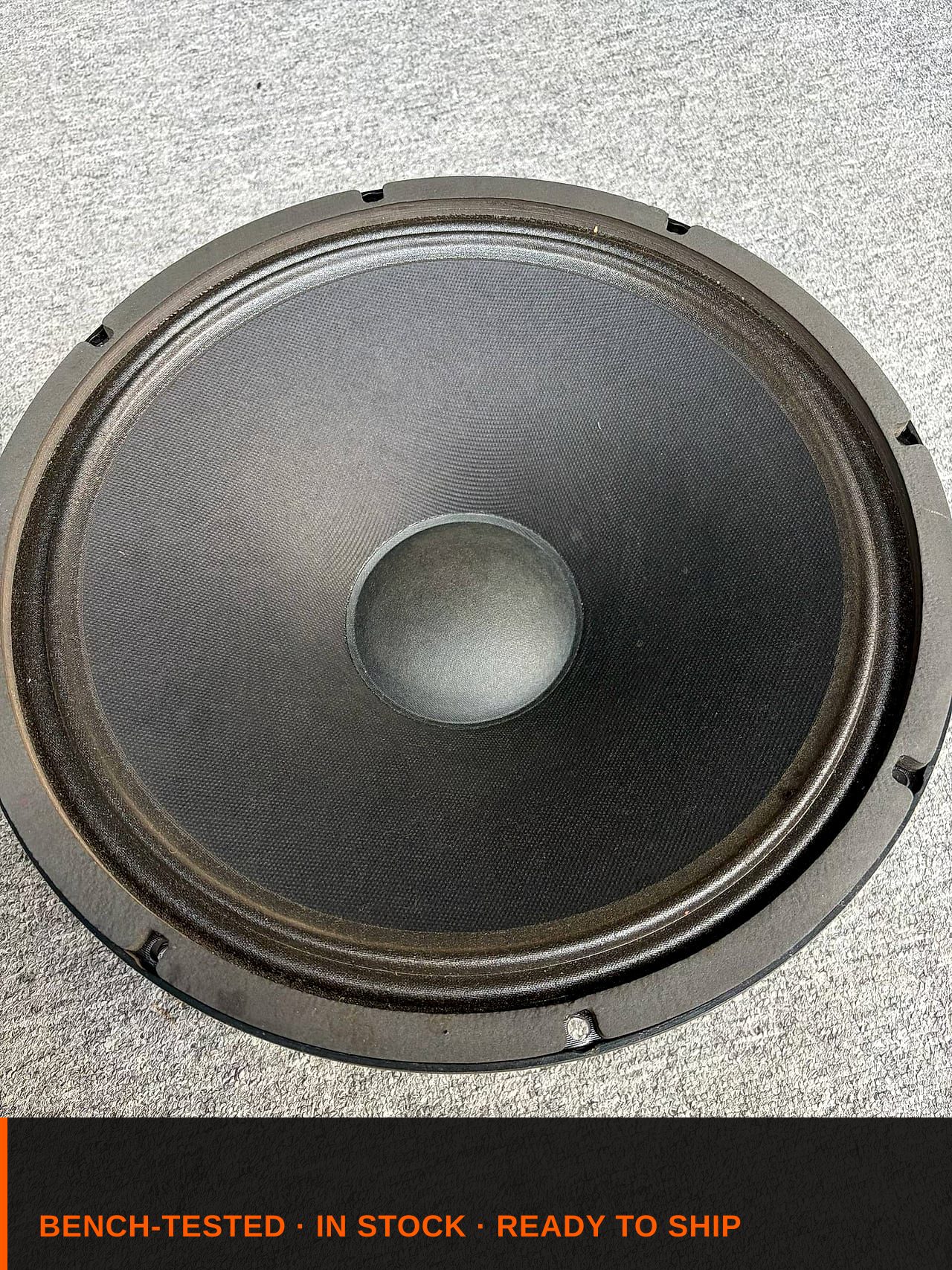
For audio engineers, rental firms, and system integrators across the CIS, Middle East, South America, and Africa, the Eminence 151351D is a known quantity: a 15-inch ferrite woofer that delivers reliable low-end reinforcement in everything from mobile DJ rigs to fixed installs. But when you’re sourcing used stock for a project or replenishing rental inventory, the question isn’t just “what does it cost?”—it’s “what does a tested, graded unit actually cost to own?” This guide breaks down where the 151351D fits, what to inspect, how pricing works in the secondary market, and how to navigate a B2B order without surprises.
Where the 151351D fits in rental and venue inventory
The 151351D is a 15-inch, 8-ohm woofer with a 2.5-inch voice coil and a ferrite magnet, typically rated around 300–400 watts AES. It’s not a subwoofer in the modern sense—it’s a mid-bass workhorse that shines in two-way tops and compact subs where weight and cost matter. Rental companies like it because it’s easy to recone, parts are widely available, and it behaves predictably when pushed. In venues, it’s common in stage monitors, fill speakers, and small PA systems where a single 15-inch driver handles both low-mid punch and vocal clarity. Integrators use it in distributed audio for clubs, houses of worship, and conference rooms where a passive 15-inch box is specified. The key is that this driver is not a boutique item—it’s a volume product, so used stock is plentiful, but condition varies wildly. That’s why buying from a B2B marketplace with grading and testing matters more than chasing the absolute lowest unit price.
Key specs that matter for integration work
When you’re matching the 151351D to an existing system, three numbers drive the decision: sensitivity, power handling, and Thiele-Small parameters. Sensitivity is typically around 97–99 dB (1W/1m), which means it doesn’t need a massive amplifier to get loud—important for rental firms running multiple boxes on a single amp channel. Power handling is often quoted as 300W AES (continuous) with 600W peak, but used units may have been reconed with non-OEM kits, which can change both power handling and tone. Always ask if the unit is original or reconed, and if reconed, what kit was used. The T/S parameters—Qts, Vas, Fs—determine whether the driver will work in a sealed, ported, or horn-loaded enclosure. A used unit that has drifted from spec (due to fatigue or a poor recone) can sound thin or boomy in a box designed for the original. For integration work, request a impedance sweep and a free-air resonance check; a healthy 151351D should show Fs close to the factory spec (typically 40–45 Hz) and a smooth impedance curve without sharp peaks. Also check the mounting depth and cutout diameter—standard for most 15-inch Eminence frames, but verify if you’re retrofitting into an existing cabinet.
Used-buying checklist: what to inspect and what to ask
Start with the cone and surround. Look for cracks, tears, or signs of re-gluing around the surround—common failure points after years of UV exposure or improper storage. The spider (the corrugated inner suspension) should be flat and intact; sagging or separated spider glue is a red flag. Check the voice coil former for rubbing: gently push the cone in and out—if you hear scraping, the coil is misaligned or the gap is dirty. Ask the seller for a photo of the back of the cone and the magnet assembly; rust on the magnet or terminals is common in humid climates (Middle East, coastal Africa) and can indicate deeper corrosion. For the terminals, look for loose or oxidized connectors—easy to fix, but a bargaining point. Ask specifically: “Has this unit been tested with a sine sweep and impedance measurement? Can you share the results?” A reputable B2B seller will have this data. Also ask about the history: was it used in a rental fleet (high hours, frequent transport) or a fixed install (lower hours, but possibly dusty)? Rental units often have cosmetic wear but may have been reconed; install units may look clean but have dried-out surrounds. Finally, request the serial number and check if it matches the original Eminence label—counterfeit or mislabeled drivers exist in the secondary market.
Price context and total cost of ownership
Used Eminence 151351D pricing varies by region and condition, but as a B2B buyer you should think in tiers: untested “as-is” units typically sell for 40–60% of the new street price (new is roughly $120–$150 USD depending on region). Tested, graded units with original cones and good impedance curves command 60–75% of new. Reconed units with quality kits sit in between, but their resale value is lower. In the CIS and Middle East, freight and customs can add 20–30% to the landed cost, so a slightly higher unit price from a seller who handles export documentation and offers consolidated shipping often beats a cheap unit with expensive logistics. Total cost of ownership also includes recone kits (around $40–$60), labor if you don’t recone in-house, and the risk of a failed unit in the field. For rental firms, a tested used unit that passes a 24-hour burn-in is worth the premium—downtime costs more than the driver. For integrators, buying a batch of graded units with matching impedance curves reduces tuning time and ensures consistent coverage across a venue. Always factor in spare units: buying 10 used drivers and keeping 2 as spares is smarter than buying 8 new ones and hoping none fail.
How a B2B order works: grade, freight, and MOQ
On a B2B marketplace, used gear is typically graded A (tested, fully functional, minor cosmetic wear), B (tested, functional, visible wear or small repairs), or C (untested or needing repair). For the 151351D, Grade A units are the safest for rental and install work; Grade B can be a good value if you have in-house recone capability. MOQs vary: some sellers require 5–10 units per order, especially for export, while others allow single units for sample orders. Freight is the biggest variable—air freight is fast but expensive for heavy drivers (each 151351D weighs around 4–5 kg), so sea or road consolidation is common for bulk orders. Ask the seller for Incoterms (FOB, CIF, DAP) and whether they can provide a commercial invoice and packing list for customs. For buyers in South America and Africa, check if the seller has experience with your country’s import regulations—audio drivers are rarely restricted, but documentation errors cause delays. Payment terms: established B2B sellers may offer 30% deposit, 70% before shipping, or net terms for repeat buyers. Always request a pre-shipment inspection report and photos of the actual units you’ll receive, not stock photos.
Sourcing used Eminence 151351D drivers is a balance of price, condition, and logistics. Focus on tested units with documented impedance sweeps, ask the right questions about recone history, and factor in landed cost rather than unit price alone. A slightly higher-priced Grade A unit from a seller who handles export and offers spares will almost always deliver better value than a cheap untested driver that fails mid-gig.