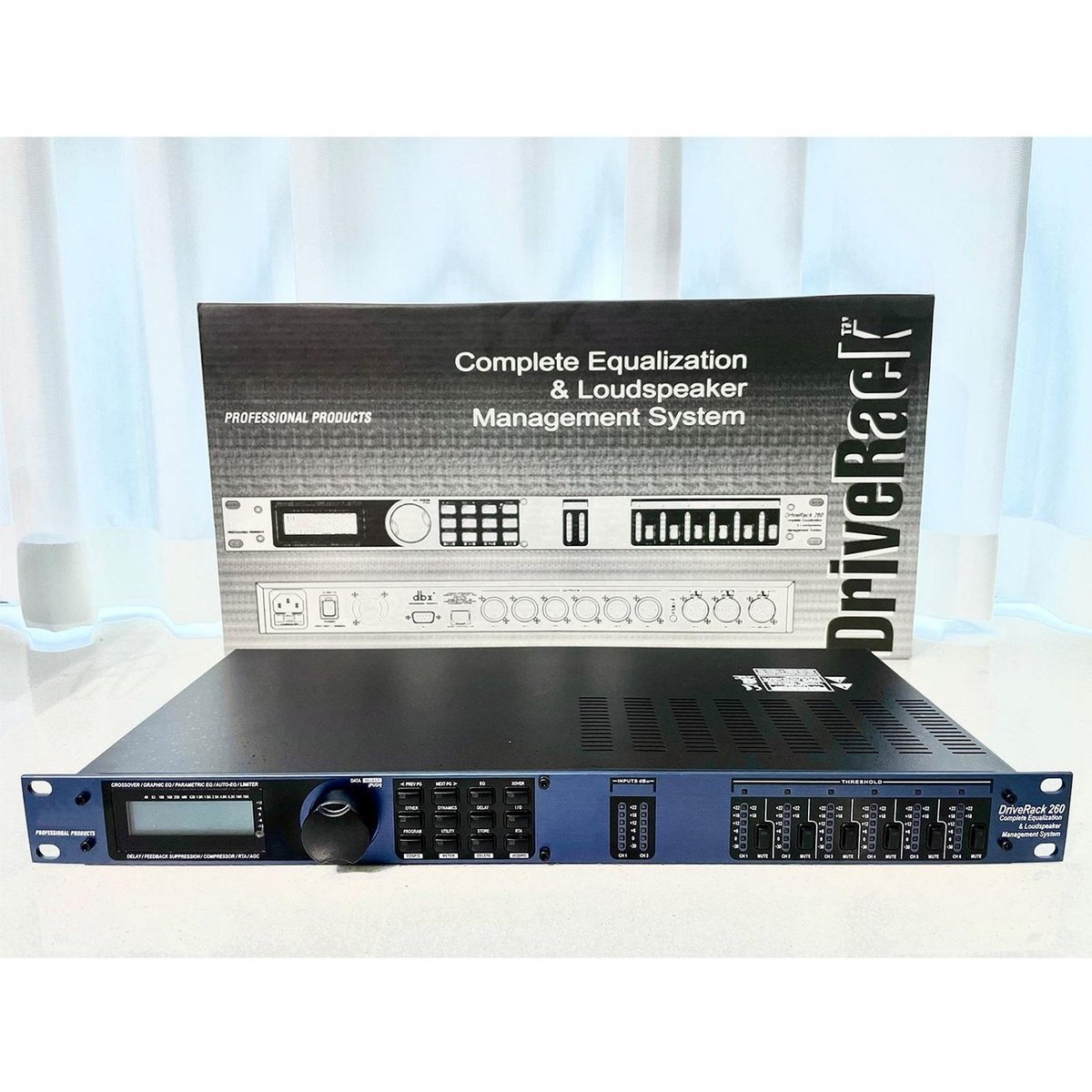
The dbx DriveRack 260 is a veteran of the loudspeaker management world, and for good reason: it packs a 2-in/6-out configuration, 28-band graphic EQs, parametric EQs, crossovers, limiters, and dbx's proprietary Advanced Feedback Suppression into a single 1U rack unit. For rental firms and integrators in CIS, the Middle East, South America, and Africa, it remains a familiar, rider-friendly workhorse that is easy to source used and simple to operate. But the used market is full of alternatives that may offer better value, more modern connectivity, or features the 260 lacks. This comparison looks at the most common used alternatives—the dbx DriveRack PA2, the Behringer DCX2496, the BSS BLU-100, and the Xilica XP-8080—to help you decide where your money is best spent.
In terms of key specs, the DriveRack 260 offers 2 analog inputs and 6 analog outputs, 24-bit/48kHz processing, and a full suite of dynamics and EQ tools. The DriveRack PA2 is a newer 2-in/6-out unit with a simplified front-panel wizard, but it drops the 260's advanced feedback suppression and offers less flexible routing. The Behringer DCX2496 is a 3-in/6-out processor with 24-bit/96kHz converters and excellent value, though its user interface and build quality are a step below the dbx. The BSS BLU-100 is a 12-in/8-out networked processor with Dante and BLU link, ideal for installed systems but overkill for simple rental racks. The Xilica XP-8080 is an 8-in/8-out unit with Ethernet control and excellent sound quality, but it is less common on riders and may require a learning curve. For most used buyers, the 260 strikes the best balance of familiarity, features, and price.
Ranking these alternatives for a used B2B buyer, the dbx DriveRack 260 comes first for its proven reliability, rider acceptance, and comprehensive feature set at a low used price. The Behringer DCX2496 is a strong second for budget-conscious rental firms that need more outputs and higher sample rates, provided they can accept a less rugged build. The dbx DriveRack PA2 is third: it is newer and easier to use, but less capable for complex systems. The BSS BLU-100 is fourth, best suited to fixed installations with networked control rather than mobile rental. The Xilica XP-8080 is fifth, a premium choice for integrators who need more I/O and Ethernet, but it is harder to find used and less familiar to visiting engineers.
When inspecting a used DriveRack 260 or any alternative, check the power supply for bulging capacitors or hum, test every input and output for noise or channel imbalance, and verify that the front-panel buttons and encoder respond reliably. On the 260, confirm that the firmware is up to date and that the unit has not been locked with a password. For the DCX2496, inspect the XLR connectors for wear and test the AES/EBU input if you plan to use it. For the BLU-100, verify the Dante card is included and functional. Always ask for a photo of the rear panel and a short video of the unit passing signal on all channels. As a next step, request a quote from a reputable used-gear marketplace that offers a warranty and return policy, and compare the total landed cost—including shipping and any import duties—before committing.