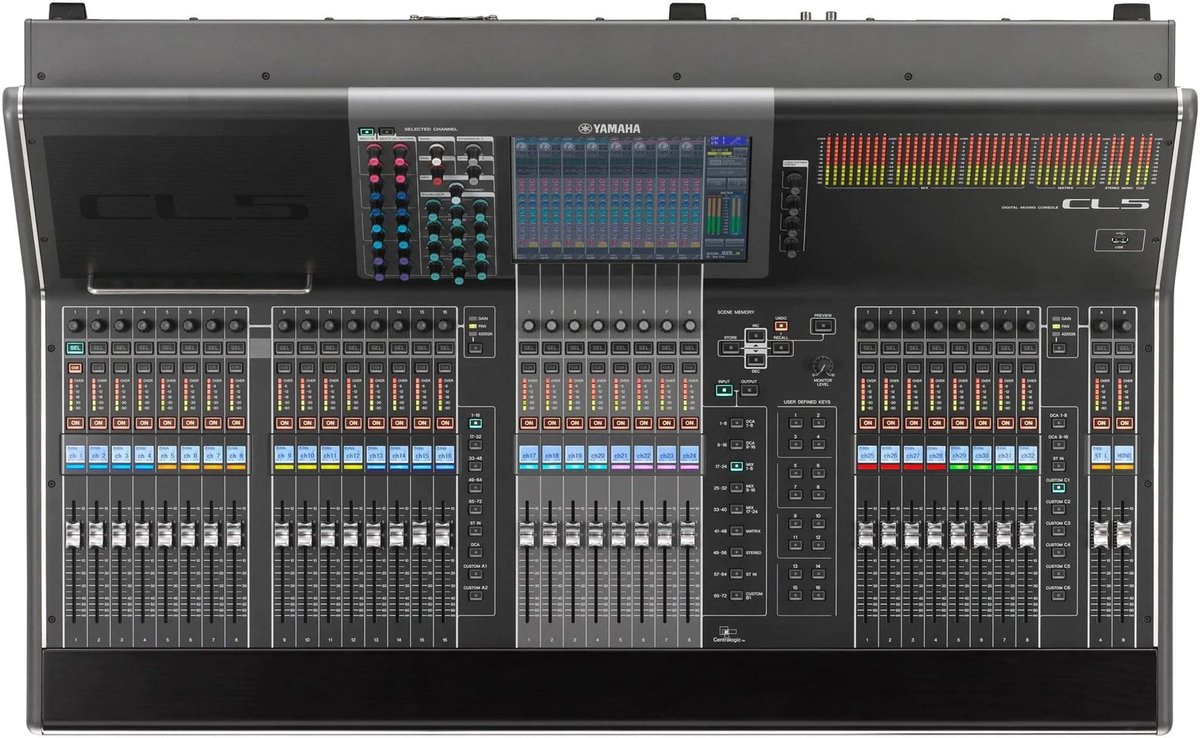
When you’re shopping for a used digital mixing console for rental, installation, or touring, the Yamaha CL5 is often at the top of the list. It’s a 72-channel, 32-fader workhorse with Dante networking, a proven reliability record, and a familiar workflow for engineers across the CIS, Middle East, South America, and Africa. But is it still the right choice in 2025, or should you consider alternatives like the DiGiCo SD10, Avid S6L-24C, Midas PRO2, or Allen & Heath dLive S5000? This comparison breaks down the key specs, real-world trade-offs, and what to inspect before you buy used.
Key specs and comparison: The Yamaha CL5 offers 72 mono + 8 stereo inputs, 32 faders, 16 mix buses, 8 matrix, and Dante as standard. The DiGiCo SD10 provides 48 flexi-channels (expandable), 37 faders, and superior onboard processing but comes at a higher used price and steeper learning curve. The Avid S6L-24C is a 24-fader system with Pro Tools integration, ideal for studio-linked live work but heavier and more expensive to maintain. The Midas PRO2 (48 channels, 24 faders) is a budget-friendly alternative with good analog-style workflow but lacks Dante natively. The Allen & Heath dLive S5000 (64 channels, 28 faders) offers a modern interface and strong FX, though its used market is thinner. In fixed ranking order for most B2B buyers: 1) Yamaha CL5 — best all-round reliability and rider acceptance; 2) DiGiCo SD10 — best for high-end touring; 3) Allen & Heath dLive S5000 — best value for modern features; 4) Avid S6L-24C — best for Pro Tools ecosystems; 5) Midas PRO2 — best budget option.
What to inspect on a used CL5 (and alternatives): Check fader life — CL5 faders are robust but can wear after heavy touring; test every fader for smoothness and motor response. Verify Dante card presence and firmware version (CL5 requires Dante-MY16-AUD or built-in Dante). Inspect the touchscreen for dead pixels or delamination, and confirm the rear panel’s XLR and TRS connectors are tight. For any used console, ask for service records, check power supply health (CL5 uses a separate PW800W PSU), and test all local I/O. On DiGiCo and Avid, pay attention to proprietary card slots and software licensing transfers. On Midas PRO2, check the AES50 ports and firmware compatibility. Always request a video of the console booting and passing audio through multiple channels.
Next step: Before committing, define your rider requirements and rental market. If your clients regularly ask for Yamaha CL series, the CL5 remains the safest investment — parts and service are widely available in the CIS and Middle East. If you need advanced processing for high-profile tours, a used DiGiCo SD10 may justify the higher price. For fixed installations in Africa or South America, the Allen & Heath dLive S5000 offers a strong feature set with lower power draw. Always buy from a reputable B2B marketplace that allows inspection, provides warranty options, and confirms firmware and licensing status. Request a quote for multiple units and compare total cost of ownership, including cases, PSU spares, and Dante cards.