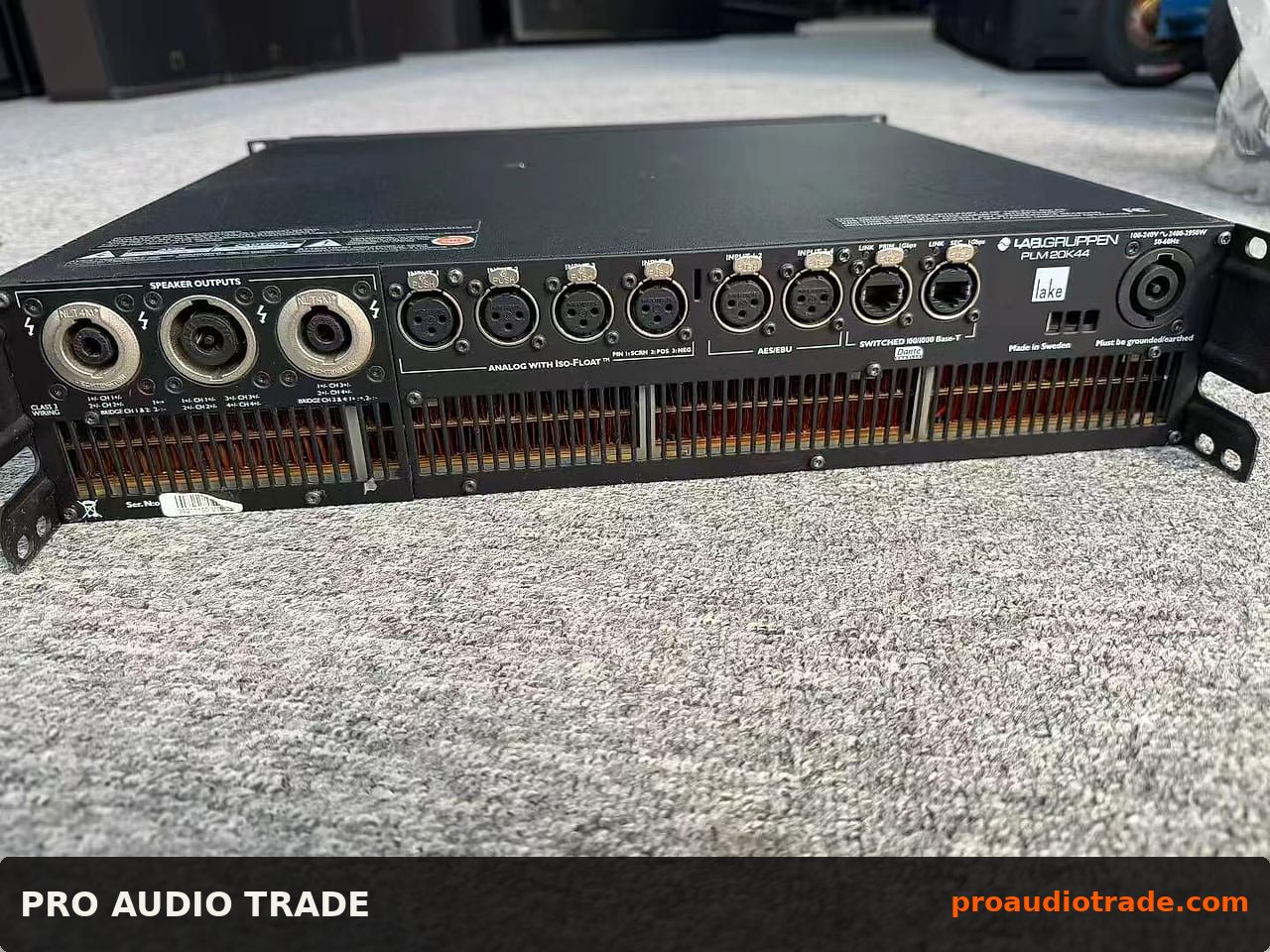
When you search for a Lab.gruppen PLM 20K44 price used, the number you see is only the entry ticket. The real cost of running a used PLM 20K44 for the next three to five years includes purchase, repair and recone, transport, insurance, and what you can recover when you sell it. This article breaks down that math so you can budget like a rental company, not a hobbyist.
Start with the purchase price and condition. A used Lab.gruppen PLM 20K44 typically trades between $4,500 and $7,500 depending on age, firmware, and whether it comes with a service history. Units from 2015–2018 with unknown hours are at the lower end; late-production units with verified service records from a Lab.gruppen authorized center command a premium. Ask the seller for the last firmware version and whether the DSP board has been replaced — early PLM series had capacitor issues that show up after 8,000–10,000 hours. If you are comparing alternatives, a Crown I-Tech 12000HD might look cheaper upfront, but its own service costs and parts availability differ, so compare total cost, not sticker price.
Repair and recone costs are where budgets break. The PLM 20K44 is a four-channel touring amp with a complex SMPS and DSP section; a single channel module failure can cost $800–$1,200 to repair at a authorized service center, and a full recone of the output stage is rarely economical. Spare boards are increasingly scarce because Lab.gruppen discontinued some PLM parts. Before buying, ask: “How do I check a used PLM 20K44 before buying?” The answer is to request a load test on all four channels at 4 ohms for at least 30 minutes, check the error log via the Lake Controller software, and verify that the fan profiles are not stuck at maximum. If the seller cannot provide that, factor in a $500–$1,000 contingency for service.
Transport and insurance add another layer. A PLM 20K44 weighs around 20 kg and ships in a 4U rack case; air freight from Europe to the Middle East or South America can run $250–$450 per unit with proper packing, and marine insurance adds 1–2% of declared value. For a single unit, that is manageable; for a rack of four, you are looking at $1,200–$1,800 before customs. Import duties vary widely: GCC countries often apply 5% on professional audio gear, while Brazil can hit 60% with state taxes. Always confirm the mains voltage configuration — the PLM 20K44 is available in 230V and 120V variants, and a mismatch means a transformer or a reconfiguration you did not budget for.
Resale value is the final piece of the math. A well-maintained PLM 20K44 holds roughly 50–60% of its purchase price after three years if you keep service records and original packaging. That is better than many digital consoles, but worse than a Crown Macro-Tech 5000i, which has a cult following among installers and holds value stubbornly. The catch: PLM resale depends on firmware and Lake processing licenses, so a unit with an expired or missing license loses 15–20% instantly. If you plan to flip the amp, buy the version with transferable Lake licenses and keep the service invoices.
Industry context matters for the math too. Rental demand for PLM-series amps remains strong in CIS and Africa because they pair well with line arrays and are rider-friendly, but the dealer landscape is thinning as Lab.gruppen focuses on newer PLM+ and D-series. That means fewer authorized service points and longer turnaround times — a real cost if the amp is on a rental fleet. Buyers on r/livesound often ask, “Is a used PLM 20K44 still worth it in 2026?” The honest answer: yes, if you buy a verified unit with service history and budget 15% of the purchase price annually for maintenance. If you are comparing to a Crown I-Tech 12000HD, note that Crown’s parts network is broader in North America but weaker in CIS, so the total cost of ownership flips depending on your region.
Closing takeaway: treat the used PLM 20K44 price as 60% of the real cost. Add 15% for annual service, 10% for transport and insurance, and subtract 50–60% resale after three years. If the math still works for your rental rate, buy the unit with the best service records — not the cheapest one on the listing.