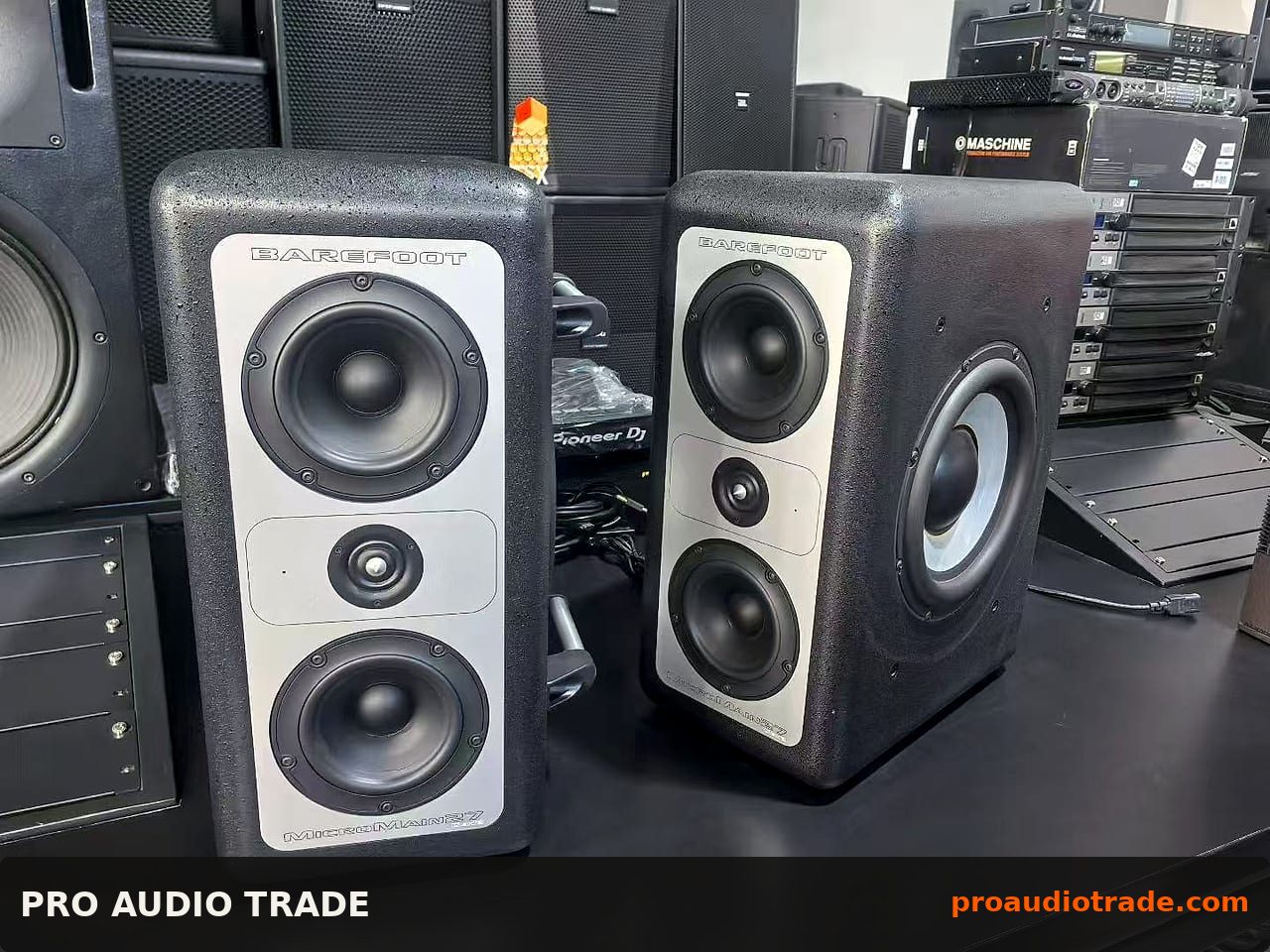
If you run a rental fleet of nearfield monitors, the Barefoot MicroMain27 Gen2 vs alternatives question isn't just about which speaker sounds better in your room — it's about which box holds value, survives tour cycles, and still has a buyer when you rotate it out. The MicroMain27 Gen2 is a serious investment-grade monitor, and in a fleet context you need to think like a trader: buy at the right point in the product cycle, rotate before the service curve gets steep, and keep documentation that makes a used unit easy to sell into CIS, the Middle East, South America, or Africa.
Start with what actually drives resale on a used MicroMain27 Gen2. The Gen2 revision brought updated amplification and DSP, and buyers in the used market specifically ask about the generation because the earlier version trades at a noticeable discount. A clean Gen2 with original boxes, proof of service, and low hours can hold roughly 55–65% of new street price after three years of light rental use, while a cosmetically rough unit with no service history drops closer to 40%. That spread is your margin. When you compare it to alternatives like the JBL VTX A12, remember the A12 is a different animal — a large-format line array element that rents by the box to production companies, not a nearfield. If your fleet is mostly studio and post rooms, the MicroMain27 Gen2 is the rotation candidate; if you're supplying live stages, the JBL VTX A12 belongs in a different depreciation bucket entirely and should be evaluated on rigging hours and driver condition, not on nearfield resale comps.
So when do you actually buy? The practical answer is: buy used units that are 2–4 years old with documented light use, because that's where the depreciation curve flattens and the service risk is still low. Avoid the temptation to buy the cheapest units on the market — those are usually ex-install or heavily toured, and the amp modules on a Barefoot are not cheap to replace. A realistic budget for a used MicroMain27 Gen2 pair in good condition sits around $6,500–$8,500 depending on region and paperwork; if a seller is asking $4,000, ask why. For fleet buyers in regions with 220–240V mains, confirm the voltage configuration before you commit, because a unit wired for 120V needs a proper step-up solution or a factory-spec change, and that affects both safety compliance and resale into CE/UL markets.
What should you rotate out, and when? The rule of thumb for rental fleets is to rotate a monitor before it hits the point where a recone or amp board replacement eats a full rental cycle's profit. On the MicroMain27 Gen2, the woofers and the amp/DSP section are the two cost centers. If a unit has been out on more than 40–50 rental weeks and shows any cone fatigue or intermittent DSP behavior, sell it while it still tests clean rather than after a failure. That's also the moment to look at alternatives that are easier to service locally — for example, the JBL SRX835P is a powered three-way that many rental houses in the Middle East and Africa can service through regional JBL channels, and its resale is liquid because live-event demand for self-powered boxes stays strong. Keep the Barefoots for the studio-tier clients and rotate the SRX835P through the live rental pool.
How do you preserve resale value across a fleet? Documentation is the whole game. Keep a service log per serial number, photograph the cones and cabinet edges before and after each rental, and store the original packaging if you can — a MicroMain27 Gen2 shipped in its factory carton sells faster and for more than one wrapped in bubble wrap. Buyers on r/livesound and in AV procurement threads consistently say they will pay a premium for units with a known history and a recent test sweep. Also mind the policy side: if you're exporting to the EU or UK, CE marking and a declaration of conformity matter; for North America, UL. Customs duty rates vary widely — for example, used audio gear into Brazil can attract 60%+ in combined import taxes, so factor that into your resale price rather than discovering it at the border. Mains voltage and plug type should be stated clearly in every listing; a 230V unit sold into a 120V market without a transformer is a returns nightmare.
Finally, think about the alternative that keeps the fleet flexible: don't standardize on one model. A mixed fleet of Barefoot MicroMain27 Gen2 for studio clients and a workhorse like the DONBN DW-12 for general rental gives you options when demand shifts, and it spreads service risk. The DW-12 is cheaper to replace and easier to move in secondary markets, so it absorbs the heavy rental cycles while the Barefoots stay protected. That strategy also makes your fleet more attractive to integrators who want a package rather than a single SKU.
The takeaway: treat every monitor as a depreciating asset with a service clock. Buy the MicroMain27 Gen2 at 2–4 years old with paperwork, rotate before the amp or woofer service hits, keep voltage and compliance documentation airtight, and let cheaper workhorses absorb the tour miles. That's how a rental fleet keeps its resale value instead of watching it evaporate.