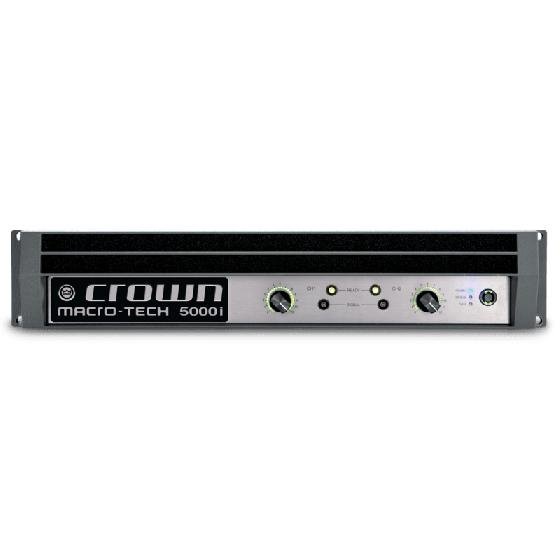
If you are sourcing a Crown Macro-Tech 5000i on the secondary market, the first question is always the same: what does a used unit actually cost? Across wholesale channels in the CIS, Middle East, South America, and Africa, clean Macro-Tech 5000i amplifiers typically trade in the $1,100–$1,800 range, with beat-up or repaired units dipping to $700–$900 and fully serviced, boxed examples with original documentation reaching $2,000+. The spread is wide because this is a 20+ year old touring amp: condition, service history, and whether the unit is a genuine 5000i (not a re-badged 5000 or a clone) drive the price far more than the model name alone.
For reference, the Macro-Tech 5000i delivers 2×1,250 W into 8 ohms, 2×2,000 W into 4 ohms, and 2×2,500 W into 2 ohms per channel, with bridge-mono operation up to 5,000 W into 4 ohms. That power density is why rental firms still hunt them: a single 5000i can drive a pair of subs or a full mid-high array without breaking a sweat. Compared with the older Macro-Tech 5000 (non-i), the 5000i adds the PIP2 input module bay and improved thermal management, which is why buyers pay a $150–$250 premium for the “i” version. Against a modern Crown XTi or DCi, the 5000i is heavier and lacks DSP, but it is cheaper per watt and easier to service in markets where Crown’s older analog designs are well understood by local techs.
Ranking used 5000i units by price tier: (1) $1,600–$2,000 — fully serviced, original box, PIP2 module included, cosmetic grade 8/10 or better; (2) $1,100–$1,500 — working units with minor scratches, no box, service history unknown but bench-tested; (3) $700–$1,000 — units with blown channels, missing knobs, or evidence of prior repair, sold as-is for parts or rebuild. Buyers in the Middle East and Africa often prefer tier 1 because shipping and customs costs make a cheap unit uneconomical if it fails; CIS and South American buyers more often take tier 2 and rebuild locally, where labor is cheaper.
Before you commit, inspect the following: output stage for burned resistors or replaced transistors (a sign of a hard life), the PIP2 module bay for corrosion or missing cards, fan operation and heatsink cleanliness, and the rear binding posts for cracks. Ask for a bench test at 4 ohms with a resistive load and a photo of the DC offset at the outputs — anything above 50 mV suggests a tired output stage. Also verify the serial number against Crown’s records if possible; counterfeit 5000i units exist, especially in online marketplaces. Once you have a shortlist, request a video of the unit powering up and idling for 10 minutes, and confirm the seller’s return policy. For wholesale quantities, ask for a mixed pallet price — many rental firms offload 4–6 units at once, and that is where the best per-unit deals are found.